


Eco-friendly thermal insulation in existing buildings: An Interview with Ulrich Steinmeyer, managing director of ÖkoPlus AG


In your presentations, you often say, “The worst thing you can do is nothing.” Do all old buildings really need to be retrofitted for energy efficiency?
Yes! Until the 1970s, most buildings in Germany weren’t insulated at all. Insulation regulations were relatively lax until 1995 compared to today’s standards. Without retrofitting existing buildings to be more energy efficient, we simply won’t succeed. No one wants to pay high heating costs in the long run, especially as energy becomes scarcer and more expensive.
Would it sometimes not be better – and perhaps cheaper – to tear down old buildings and build new ones?
Yes, that can happen. For a presentation at The Nature and Biodiversity Conservation Union (NABU), I used life-cycle assessments for CO2 and primary energy to determine the eco-friendlier option: retrofitting an old building for energy efficiency or tearing it down and building a new one. The result depends on how well a building can be renovated and what kind of new building would replace it. Furthermore, demolition and new construction can be cheaper than an energy-intensive renovation. In most cases, however, a professional renovation is preferable to demolition.
Which is more efficient? Adding thermal insulation or upgrading the building services systems?
As a rule, both are necessary. In residential buildings, about four times more energy is consumed for heating than for electricity. Even with heat pumps, it would be difficult to meet the total energy demand with renewable energy sources. Therefore, renovating old, poorly insulated buildings to improve energy efficiency is always a good idea. In addition, renovating would improve living conditions. Cold walls often lead to moisture problems and mold. Using building biology methods when renovating can significantly improve the indoor climate. Upgrading building service systems to utilize renewable energy is also necessary. Currently, about 85% of heating needs are met by fossil fuels. Good insulation and renewable energy systems are essential for a climate-friendly future.
The use of renewable energy sources, such as wind power, is growing rapidly. So, does it make sense to invest in energy-saving measures?
Of course it helps. However, as I said before, it will be difficult to heat poorly insulated buildings with electricity from renewable energy sources alone. Where will all the wind turbines go, and where will the space for PV modules come from? Furthermore, other consumers, such as the transportation sector and industry, also want a share of „green electricity.“ That will be difficult.
How can we insulate older buildings, such as historic landmarks, while preserving their charm?
There are a number of building practices that can help with this. For example, interior insulation can be used for facades that are worth preserving. Often, such buildings cannot be brought up to the same high standards as new construction. However, improvements of 25% to 33% compared to the unrenovated state are usually achievable. The rest must be provided by renewable building services systems.
How much energy – and thus operating costs – can be saved in existing buildings?
Thermal insulation has the greatest impact. Compared to uninsulated buildings, it can reduce heating energy consumption by up to 90%. Even simpler insulation measures can reduce energy consumption by 60% to 75%. This is often unachievable with modern heating technology. While a minimum factor of 3 is typically achievable, very good heat pumps can generate 5 kWh of heat from 1 kWh of electricity (an annual coefficient of performance of 5). The situation is different when it comes to costs. Since a kWh of electricity costs three to four times as much as a kWh of gas, the savings aren’t significant.

Ulrich Steinmeyer gives a presentation on "Eco-friendly Insulation in Existing Buildings."
Renovation of an old building: exterior insulation with soft fiberboard and blow-in insulation
Renovation of an old building: wood frame construction with interior cellulose insulation
Renovation of an old building: adding thermal insulation on the upper floor slab in a cold attic
Renovation of an old building: thermal insulation on the ground floor slab above the basement1 Ulrich Steinmeyer gives a presentation on „Eco-friendly Insulation in Existing Buildings.“2 Renovation of an old building: exterior insulation with soft fiberboard and blow-in insulation3 Renovation of an old building: wood frame construction with interior cellulose insulation4 Renovation of an old building: adding thermal insulation on the upper floor slab in a cold attic5 Renovation of an old building: thermal insulation on the ground floor slab above the basement
What does „eco-friendly insulation“ mean? Can any insulation be described as eco-friendly?
Eco-friendly insulation has a low ecological footprint in terms of production, use, and disposal. Old polystyrene insulation boards could not be disposed of anywhere until the federal government repealed the regulations governing their disposal. Conventional insulation materials, such as polystyrene, polyurethane foam, and mineral wool, generally consume more energy and have a greater environmental impact than natural materials, such as hemp, wool, cellulose, and straw.
Is eco-friendly insulation more expensive than conventional insulation?
As always, the answer depends on the specific materials and designs. Currently, cellulose is usually cheaper than mineral wool, partly because it can be produced using significantly less energy. For interior insulation of exterior walls, capillary-active materials are necessary. Conventional insulation materials cannot do this. For exterior insulation and finish systems (EIFS), conventional polystyrene insulation is cheaper than systems that use soft fiberboards and mineral plasters. However, polystyrene insulation requires toxic paint to prevent algae growth. This only works for a limited time, about 10 to 15 years. After that time, the surface must be cleaned and treated with new „fungicidal“ paint. In contrast, facades with soft fiberboard insulation and mineral plasters can buffer moisture and are highly alkaline. This provides decades of protection against algae growth, eliminating the need for fungicidal paint. Although the latter is more expensive, it is non-toxic and requires significantly less frequent maintenance.
What are some common renovation solutions with eco-friendly insulation?
One solution is to use interior insulation made of capillary-active materials, such as soft fiberboards or straw boards with clay. Other solutions include using cellulose insulation for roofs or upper floor slabs. Since these materials are usually blown in, they can reach cavities that would otherwise be impossible to insulate, such as uninsulated roof slopes. In this context, natural building materials are quite affordable compared to conventional ones. For facades, we often use soft fiberboards attached to furring strips on the exterior wall and finished with lime or silicate plaster. The cavities are then filled with cellulose. These are just a few examples among many. Depending on the region and type of old building, a variety of practical solutions can be found.
Which insulation measures are particularly effective?
„Effective“ generally means low effort and cost relative to the benefit and insulation value. Blown-in insulation systems, in particular, have proven to be the most popular. Since around 1900, most residential masonry buildings in northern Germany have been constructed with a double-shell design. Until the 1970s, these buildings were constructed without insulation. This leaves a cavity that typically measures 4 to 7 cm (1.8 to 2.8 in), into which insulation material can be blown. With 6 cm (2.4 in) of insulation, heat loss through the walls decreases by 60%. If a vaulted ceiling is accessible from the attic, you can insulate it from above using bags filled with insulation or by installing hardboard panels as a retrofitted suspended structure. These insulation measures usually pay for themselves within three to five years. During this time, enough energy costs are saved to cover the installation costs. Other measures, such as exterior wall insulation, often take 20 years to pay off.
What energy-saving measures would you recommend to homeowners on a tight budget?
First and foremost, those involving blown-in insulation. Another option is to install the insulation yourself. For example, you could insulate the ground floor slab from below in the basement or the upper floor slab from above in the attic.
Several funding options are available for the energy-efficient renovation of existing buildings. Which of these would you recommend?
All options that apply to a specific project. Simple measures like blown-in insulation generally aren’t eligible for grants or rebates because they don’t achieve the higher insulation values required for funding. However, you can usually claim them as a tax deduction when purchased as a contractor’s service. Take advantage of grants and rebates whenever plans are made to insulate exterior walls or replace windows.
Which professionals are best suited to advise and guide homeowners through the mazes of technical knowledge, installation details, financing, and rebates?
Unfortunately, most „experts“ specialize in conventional construction projects. They are often unaware of the possibilities offered by methods recommended by building biology. Therefore, you should consult energy consultants and/or designers who are familiar with natural insulation materials. Contact natural building materials suppliers, building biology institutions and consulting offices to find suitable experts. Just ask them.
Ulrich Steinmeyer has a degree in economics, is a Certified Passive House Tradesperson, and has been the managing director of ÖkoPlus AG since 2015. While studying in Bremen, he lived with fellow students in a rural commune in an old farmhouse. While renovating the building, they used natural building materials, which were difficult to find at the time. In 1995, they therefore founded a store for natural building materials in Verden an der Aller called the „Biber“ hardware store. Steinmeyer has been one of the managing directors ever since. He is also a co-founder of the Ökozentrum in Verden (1998), the eco-community of Neumühlen (2004) – where he currently lives with his family in a Passive House – and the Norddeutsches Zentrum für Nachhaltiges Bauen (NZNB) (2014). The NZNB is a 5-story straw bale building that houses several businesses and professional associations. It also serves as a venue for information, consulting, and continuing education, including a large exhibition.
This is a translation of “Ökologische Wärmedämmung im Bestand – Interview mit Ulrich Steinmeyer, Vorstand der ÖkoPlus AG“
Translator
Katharina Gustavs is a Building Biology Professional in Victoria, Canada, who translated the Building Biology Online Course IBN.
info@katharinaconsulting.com | katharinaconsulting.com
Deine Stimme zählt
Kommentarregeln:
Wir sind neugierig, was du zu sagen hast. Hier ist Raum für deine Meinung, Erfahrung, Stellungnahme oder ergänzende Informationen. Bitte beachte bei deinem Kommentar folgende Regeln:
- Solltest du zu diesem Beitrag Fragen haben, stelle Sie bitte direkt an unsere Autoren - deren Kontaktdaten findest du oben rechts.
- Bitte keine Werbung: Gerne kannst du auf deine Dienstleistungen mit einem Werbebanner aufmerksam machen.
Passende Beiträge im Magazin
Passende Fragen & Antworten
Passende Literaturtipps



Wie werde ich
Baubiolog*in IBN?
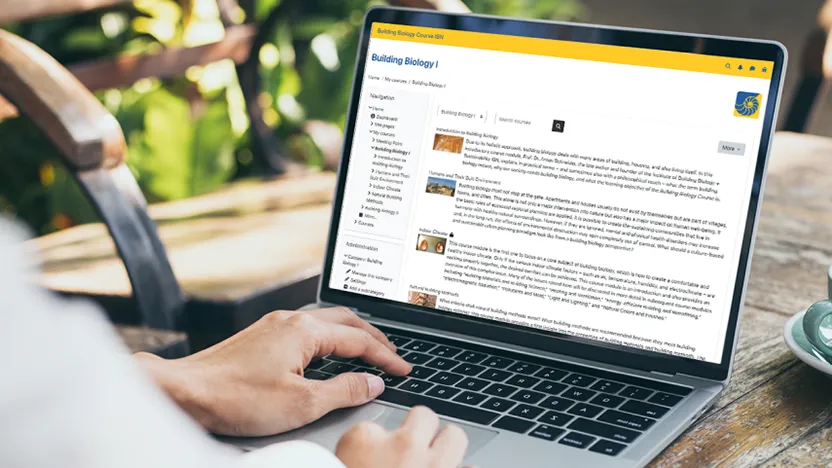
How to become a Building Biology Consultant IBN?
Newsletter

„Aktuelles aus der Baubiologie“
Die Baubiologie entwickelt sich stetig weiter: neue Erkenntnisse aus Praxis und Wissenschaft, innovative Materialien, Methoden und Projekte, spannende Veranstaltungen und Publikationen ... Wir bleiben dran und bündeln die interessantesten Neuigkeiten monatlich in unserem kostenlosen Newsletter.Nachhaltig weiterbilden
Know-how, Zusatzqualifikationen und neue berufliche Möglichkeiten für Baufachleute sowie alle, die sich für gesundes, nachhaltiges Bauen und Wohnen interessieren.
Unser Kompetenz-Netzwerk
Hier finden Sie unsere qualifizierten Baubiologischen Beratungsstellen und Kontakte im In- und Ausland nach Standort und Themen sortiert.
Über die Baubiologie
Die Baubiologie beschäftigt sich mit der Beziehung zwischen Menschen und ihrer gebauten Umwelt. Wie wirken sich Gebäude, Baustoffe und Architektur auf Mensch und Natur aus? Dabei werden ganzheitlich gesundheitliche, nachhaltige und gestalterische Aspekte betrachtet.
25 Leitlinien
Für einen schnellen, aufschlussreichen Überblick haben wir in 25 Leitlinien der Baubiologie die wichtigsten Parameter herausgearbeitet, sortiert und zusammengefasst. In 17 Sprachen, als PDF oder als Plakat erhältlich.

























0 Kommentare