


Interview with Dr. Ipek Ölcüm from the Industry Association for Clay Building Materials (Industrieverband Lehmbaustoffe e.V. – IV Lehm)


Why was IV Lehm founded?
The founding members wanted to raise awareness about the industrial scale of building with clay and manufacturing clay building materials. They also wanted to remove existing obstacles.
What inspired your decision to become the managing director at IV Lehm?
I was inspired by the opportunity to create and shape the association’s structures alongside the companies. In my opinion, clay is also a fascinating building material with the potential to transform the construction industry. In this sense, I find Prof. Thomas Auer’s resilient approach very apt. It involves learning from the past while using today’s technology.
(Editor’s note: Prof. Thomas Auer is the chair of building technology and climate responsive design at the Technical University of Munich.)

Clay brick production
Installation of rammed earth prefabricated elements using a crane
Installation of clay panels with screws1 Clay brick production2 Installation of rammed earth prefabricated elements using a crane3 Installation of clay panels with screws
What is the current market share of clay, and what potential do you see for its growth in the future?
The market share is still extremely small. However, the potential is enormous. This is particularly relevant given the growing importance of climate-resilient construction, even with low-tech solutions. Clay products offer solutions that align with the principle of „less is more“ due to their thermal mass and moisture absorption capacity.
How can clay products and other products recommended by building biology become more visible and successful in society, business, and politics?
First, information about clay products must be more easily accessible. What can designers and contractors already do with the existing building materials? Investors are considering the long-term viability of their investments and construction projects. It is also important for clay products to shed counterproductive images, such as being considered a „luxury product“ or a „Stone Age“ building material. In terms of price, clay plaster and clay bricks are competitive. Many people are not yet familiar with unfired clay bricks. In addition to meeting product standards for clay bricks and mortar, unfired clay bricks have had a design standard (DIN 18940:2023:06) since 2023. Based on this standard, load-bearing structures up to 13 meters high (building class 4) can be built. In my opinion, this is a game changer that we want to publicize more widely. We can also produce clay blocks (Planblock) that are molded and laid with clay thin-bed mortar, up to a size of thin format bricks measuring 247 x 49 x 249 mm (16 DF). This is not a pipe dream; it has already been realized.
Which clay building methods and technologies will capture larger market shares, and which will not?
These are challenging times. We must build and renovate in a climate-friendly way. At the same time, everything must be done quickly and affordably. I therefore assume that industrially produced, economically feasible materials and components, such as prefabricated building materials, will become mainstream in future construction. For example, floor slabs are responsible for around 30% of carbon dioxide emissions in concrete buildings. Using wood-clay ceilings, as in the case of the Association for Rural Development in Tirschenreuth, reduces these emissions while improving the building’s indoor climate and circularity. Currently, rammed earth and masonry walls are also prefabricated, and as demand increases, this option will become more cost-effective. While large load-bearing structures made of rammed earth are popular, they are still too time-consuming and labor-intensive to produce. However, this may change with advances in robotics and automation technology.

Wood-clay ceiling
Detmold Open-air Museum with rammed earth walls
Wood-clay research house in Bad Aibling4 Wood-clay ceiling5 Detmold Open-air Museum with rammed earth walls6 Wood-clay research house in Bad Aibling
Smaller clay construction companies and tradespeople view industrial clay production as competition. Is this fear justified?
We believe that the enormous challenges of sustainable construction can only be overcome through collaboration and production on an industrial scale. That is why, from the beginning, we joined the German Association for Building with Earth (Dachverband Lehm – DVL), an umbrella organization whose work we support. We collaborate on many issues. Thanks to this partnership, I was able to have many productive conversations with tradespeople at the 9th International Clay Conference, which was organized by the DVL in 2024. We communicate openly, and I believe a trusting relationship has developed. As demand for clay building materials increases, more of them will be produced and sold. Consequently, more tradespeople and clay construction companies will be needed to process and distribute them. Given the growth potential of clay building products and methods, there is certainly enough room for all.
As far as we know, Germany is a pioneer in modern clay construction. What is the current international situation?
Germany is already far ahead in this area, especially when it comes to standardization. Consider the recent development of thin-bed clay mortar, for example. Compared to thick-bed clay mortar, it allows for more economical bricklaying and single-material construction. Building materials for wall assemblies, such as bricks and sand-lime bricks, can be separated by type if bonded with thin-bed clay mortar because the clay is water-soluble. Other countries often look to the developments in Germany for inspiration. We are happy to share our expertise. We will have the opportunity to do so again soon at a digital event organized by the „Climate Lab“ in Austria.
The brick manufacturer Schlagmann/Poroton now offers both fired and unfired bricks with its „Lehmbloc“ products. Do you see this as the beginning of a meaningful coexistence between fired bricks and unfired clay products?
Absolutely! Leipfinger-Bader, an innovative brick manufacturer from Bavaria, was one of the initiators behind the founding of IV Lehm. They manufacture clay building materials and components. Bricks and clay go hand in hand, as do sand-lime bricks. One of our members is Kimm Baustoffe GmbH & Co. KG, which manufactures molded clay blocks under the Conclay brand, among other products. Both bricks and sand-lime bricks are excellent materials for building walls. Clay complements them with its excellent properties.
Advantages of clay as a building material
Clay enables sustainable, climate-resilient, and healthy construction and renovation because:
- Requires low energy for manufacturing
- Circular building material (remoldable)
- Reusable
- Regionally available resource
- Thermal mass (essential for low-tech construction)
- Buffers moisture
- Absorbs pollutants
- Stores heat
- Provides thermal comfort in summer
- Sound-absorbing
What opportunities for collaboration do you envision between IV Lehm, the IBN, and the IBN Building Biology Consulting Offices?
We are open to suggestions. We certainly have a strong connection when it comes to healthy indoor environmental quality and sustainability. For this reason, I am confident that there will be opportunities for us to collaborate.
Please tell us a little about your daily work. What are your responsibilities? What kind of contacts are you looking for, and what kind are you finding? What kind of reactions do you encounter?
My responsibilities are very varied. I speak with people in the construction industry, politicians, and government agency representatives to raise awareness about our clay building materials and components. I conduct discussions and interviews, give presentations, and connect individuals involved in construction and renovation projects that use clay. I welcome anyone interested in building with clay and enjoy talking to those who are still hesitant about using it.
What fascinates you most about clay as a building material?
I am fascinated by the fact that clay is infinitely recyclable and requires little energy to produce. The more I learn about clay, the more impressed I am by its physical properties. I am also excited to contribute to the increased demand for clay and allow more people to enjoy its benefits.
Below is a brief introduction to the Industry Association for Clay Building Materials (Industrieverband Lehm e.V. – IV Lehm):
Founded: November 2022 in Berlin
Members: 21 (as of January 2025) – mostly companies
Executive: Lea Hart, with Maximilian Breidenbach and Thomas Bader as deputies
More info: www.iv-lehm.de and on LinkedIn
This is a translation of “Interview mit Dr. Ipek Ölcüm vom Industrieverband Lehmbaustoffe e.V.„
Translator
Katharina Gustavs is a Building Biology Professional in Victoria, Canada, who translated the Building Biology Online Course IBN.
info@katharinaconsulting.com | katharinaconsulting.com
Deine Stimme zählt
Kommentarregeln:
Wir sind neugierig, was du zu sagen hast. Hier ist Raum für deine Meinung, Erfahrung, Stellungnahme oder ergänzende Informationen. Bitte beachte bei deinem Kommentar folgende Regeln:
- Solltest du zu diesem Beitrag Fragen haben, stelle Sie bitte direkt an unsere Autoren - deren Kontaktdaten findest du oben rechts.
- Bitte keine Werbung: Gerne kannst du auf deine Dienstleistungen mit einem Werbebanner aufmerksam machen.
Passende Beiträge im Magazin
Passende Fragen & Antworten
Passende Literaturtipps



Wie werde ich
Baubiolog*in IBN?
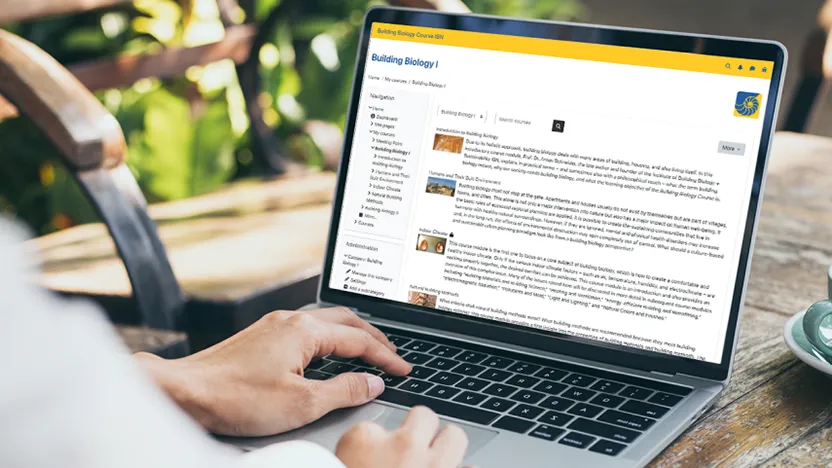
How to become a Building Biology Consultant IBN?
Newsletter

„Aktuelles aus der Baubiologie“
Die Baubiologie entwickelt sich stetig weiter: neue Erkenntnisse aus Praxis und Wissenschaft, innovative Materialien, Methoden und Projekte, spannende Veranstaltungen und Publikationen ... Wir bleiben dran und bündeln die interessantesten Neuigkeiten monatlich in unserem kostenlosen Newsletter.Nachhaltig weiterbilden
Know-how, Zusatzqualifikationen und neue berufliche Möglichkeiten für Baufachleute sowie alle, die sich für gesundes, nachhaltiges Bauen und Wohnen interessieren.
Unser Kompetenz-Netzwerk
Hier finden Sie unsere qualifizierten Baubiologischen Beratungsstellen und Kontakte im In- und Ausland nach Standort und Themen sortiert.
Über die Baubiologie
Die Baubiologie beschäftigt sich mit der Beziehung zwischen Menschen und ihrer gebauten Umwelt. Wie wirken sich Gebäude, Baustoffe und Architektur auf Mensch und Natur aus? Dabei werden ganzheitlich gesundheitliche, nachhaltige und gestalterische Aspekte betrachtet.
25 Leitlinien
Für einen schnellen, aufschlussreichen Überblick haben wir in 25 Leitlinien der Baubiologie die wichtigsten Parameter herausgearbeitet, sortiert und zusammengefasst. In 17 Sprachen, als PDF oder als Plakat erhältlich.

























0 Kommentare